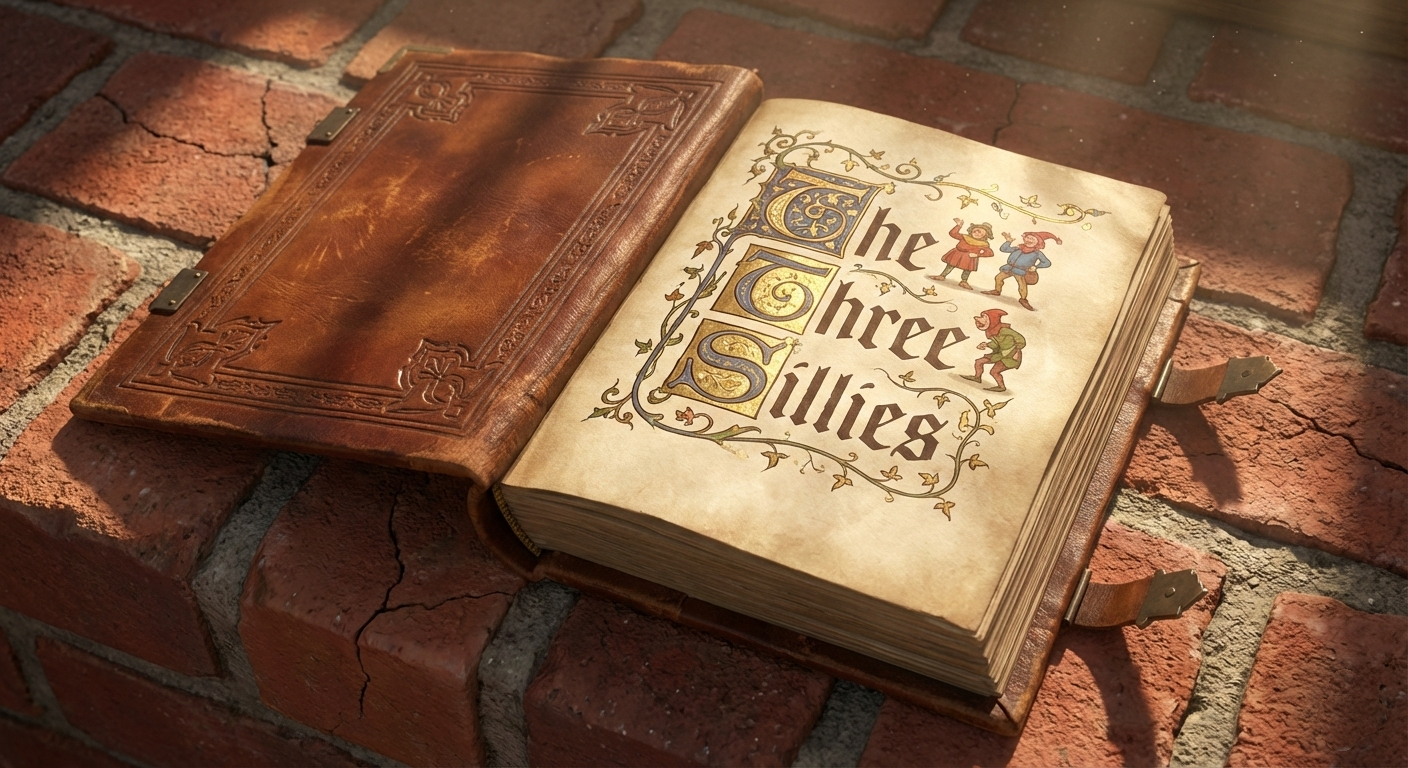
THE THREE SILLIES
Once upon a time, when folk were not so wise as they are nowadays, there lived a farmer and his wife who had one daughter. And she, being a pretty lass, was courted by the young squire when he came home from his travels.
Now every evening he would stroll over from the Hall to see her and stop to supper in the farm-house, and every evening the daughter would go down into the cellar to draw the cider for supper.
三ê戇á
古早古早,tī hit ê人iáu無像chit-má chiah-nī巧ê時代,有1 ê做穡人kah in bó͘,in有1 ê cha-bó͘-kiáⁿ。Chit ê cha-bó͘-kiáⁿ生kah真súi,só͘-pái,in hia有1 ê少年ê草地紳士ùi伊ê遊學轉--來了後,to̍h去ka phāⁿ。
Taⁿ,ta̍k日ê暗頭á,草地紳士to ē ùi伊ê大厝宅散步過kā cha-bó͘ gín-á看看--leh,mā ē留落來tī農舍食暗,ah ta̍k暗chit-ê cha-bó͘ gín-á lóng ē去地陷(tē-hām) the̍h暗頓beh ài lim ê蘋果酒。
Saⁿ ê Gōng-á
Kó͘-chá Kó͘-chá, tī hit ê lâng iáu bô chhiūⁿ chit-má chiah-nī khiáu ê sî-tāi, ū 1 ê chò-sit-lâng kah in bó͘, in ū 1 ê cha-bó͘-kiáⁿ. Chit ê cha-bó͘-kiáⁿ seⁿ kah chin súi, só͘-pái, in hia ū 1 ê siàu-liân ê chháu-tē sin-sū ùi i ê iû-ha̍k tńg--lâi liáu-āu, to̍h khì ka phāⁿ.
Taⁿ, ta̍k-ji̍t ê àm-thâu-á, chháu-tē sin-sū to ē ùi i ê tōa-chhù-the̍h sàn-pō͘ kòe kā cha-bó͘ gín-á khòaⁿ-khòaⁿ--leh, mā ē lâu lo̍h-lâi tī lông-sià chia̍h-àm, ah ta̍k àm chit-ê cha-bó͘ gín-á lóng ē khì tē-hām the̍h àm-tǹg beh ài lim ê phōng-kó-chiú.
So one evening when she had gone down to draw the cider and had turned the tap as usual, she happened to look up at the ceiling, and there she saw a big wooden mallet stuck in one of the beams.
It must have been there for ages and ages, for it was all covered with cobwebs; but somehow or another she had never noticed it before, and at once she began thinking how dangerous it was to have the mallet just there.
有1 kang,伊to̍h像普通時á án-ne落去地陷入蘋果酒,kā漏酒ê choān-á choān--開了後,伊無張持攑頭去看天pông,soah看tio̍h有1支大柴槌á khê tī其中1支大樑頂koân。
Chit支大柴槌á決定是早to̍h tī hia chiok久chiok久--ah,因為kui支lóng hō͘蜘蛛絲am kah bā-bā;m̄-koh mā m̄知影是án-chóaⁿ,nah ē éng過伊從來to̍h無去ka注意--tio̍h,taⁿ,伊sûi to̍h開始想講,chit支柴槌á khê tī hia tàu底是有jōa危險。
Ū 1 kang, i to̍h chhiūⁿ phó͘-thong-sî-á án-ne lo̍h-khì tē-hām ji̍p phōng-kó-chiú, kā lāu chiú ê choān-á choān--khui liáu-āu, i bô-tiuⁿ-tî gia̍h-thâu khì khòaⁿ thian-pông, soah khòaⁿ tio̍h ū 1 ki tōa chhâ-thûi-á khê tī kî-tiong 1 ki tōa-niû téng-koân.
Chit ki tōa chhâ-thûi-á koat-tēng sī chá to̍h tī hia chiok kú chiok kú--ah, in-ūi kui ki lóng hō͘ ti-tu-si am kah bā-bā; m̄-koh mā m̄-chai-iáⁿ sī án-chóaⁿ, nah ē éng-kòe i chiông-lâi to̍h bô khì ka chù-ì--tio̍h, taⁿ, i sûi to̍h khai-sí siūⁿ-kóng, chit ki chhâ-thûi-á khê tī hia tàu-té sī ū jōa hûi-hiám.
"For," thought she, "supposing him and me was married, and supposing we was to have a son, and supposing he were to grow up to be a man, and supposing he were to come down to draw cider like as I'm doing, and supposing the mallet were to fall on his head and kill him, how dreadful it would be!"
And with that she put down the candle she was carrying and, seating herself on a cask, began to cry. And she cried and cried and cried.
「To,」伊想講:「Nā準講我hâm伊結婚,koh準講阮生1 ê kiáⁿ,koh準講gín-á大漢成年,koh準講伊to̍h像我chit-má án-ne落來the̍h蘋果酒,koh準講hit支柴槌á lak落來khian tio̍h伊ê頭,chŏaⁿ ka khian--死,án-ne是jŏa-nī-á恐怖ê tāi-chì--ah! 」
想到chia來,伊chŏaⁿ kā手--ni̍h ê蠟條hē--leh,坐去 1 ê酒桶頂koân開始哭。伊哭了koh哭,直直哭,一直哭。
“To,” i siūⁿ-kóng: “Nā chún-kóng góa hâm i kiat-hun, koh chún-kóng goán seⁿ 1 ê kiáⁿ, koh chún-kóng gín-á tōa-hàn sêng-liân, koh chún-kóng i to̍h chhiūⁿ góa chit-má án-ne lo̍h-lâi the̍h phōng-kó-chiú, koh chún-kóng hit ki chhâ-thûi-á lak lo̍h-lâi khian tio̍h i ê thâu, chŏaⁿ ka khian--sí, án-ne sī jŏa-nī-á khióng-pò͘ ê tāi-chì--ah!”
Siūⁿ kàu chia lâi, i chŏaⁿ kā chhiú--ni̍h ê la̍h-tiâu hē--leh, chē khì 1 ê chiú-tháng téng-koân khai-sí khàu. I khàu liáu koh khàu, ti̍t-ti̍t khàu, it-ti̍t khàu.
Now, upstairs, they began to wonder why she was so long drawing the cider; so after a time her mother went down to the cellar to see what had come to her, and found her, seated on the cask, crying ever so hard, and the cider running all over the floor.
"Lawks a mercy me!" cried her mother, "whatever is the matter?"
Taⁿ,換樓頂ê人開始teh奇怪講,nah ē the̍h 1-ē蘋果酒 the̍h kah無khoàiⁿ人;só͘-pái,koh過--1-時-á,in老母to̍h落去地陷看伊是án-chóaⁿ--ah,來to̍h看tio̍h伊坐tī酒桶面頂,哭kah chiok悽慘,ah he蘋果酒是流kah kui土脚。
「天公伯--á保庇喔!」In老母大聲hoah講:「到底是發生啥tāi-chì?」
Taⁿ, ōaⁿ lâu-téng ê lâng khai-sí teh kî-koài kóng, nah ē the̍h 1-ē phōng-kó-chiú the̍h kah bô-khoàiⁿ lâng; só͘-pái, koh kòe--1-sî-á, in lāu-bú to̍h lo̍h-khì tē-hām khòaⁿ i sī án-chóaⁿ--ah, lâi to̍h khòaⁿ tio̍h i chē tī chiú-tháng bīn-téng, khàu kah chiok chhi-chhám, ah he phōng-kó-chiú sī lâu kah kui thô͘-kha.
“Thiⁿ-kong-peh--á pó-pì--o͘h!” In lāu-bú tōa-siaⁿ hoah kóng: “Tàu-té sī hoat-seng siáⁿ tāi-chì?”
"O mother!" says she between her sobs, "it's that horrid mallet. Supposing him and me was married, and supposing we was to have a son, and supposing he was to grow up to be a man, and supposing he was to come down to draw cider like as I'm doing, and supposing the mallet were to fall on his head and kill him, how dreadful it would be!"
「阿母ôe!」伊ná chhngh ná ìn講:「是hit支恐怖ê柴槌--lah。Nā準講我hâm伊結婚,koh準講阮生1 ê kiáⁿ,koh準講gín-á大漢,koh準講伊to̍h像我chit-má án-ne落來the̍h蘋果酒,koh準講hit支柴槌á lak落來khian tio̍h伊ê頭去ka khian--死,he真正是連想to m̄敢想ê恐怖--lah! 」
“A-bú ôe!” I ná chhn̍gh ná ìn kóng: “Sī hit ki khióng-pò͘ ê chhâ-thûi--lah. Nā chún-kóng góa hâm i kiat-hun, koh chún-kóng goán seⁿ 1 ê kiáⁿ, koh chún-kóng gín-á tōa-hàn, koh chún-kóng i to̍h chhiūⁿ góa chit-má án-ne lo̍h-lâi the̍h phōng-kó-chiú, koh chún-kóng hit ki chhâ-thûi-á lak lo̍h-lâi khian tio̍h i ê thâu khì ka khian--sí, he chin-chiàⁿ sī liân siūⁿ to m̄-káⁿ siūⁿ ê khióng-pò͘--lah!”
"Dear heart!" said the mother, seating herself beside her daughter and beginning to cry: "How dreadful it would be!"
So they both sat a-crying.
「命命kiáⁿ--eh!」In老母mā tī in chŏ͘-kiáⁿ ê seng-khu邊坐--落-來,tòe leh開始háu,koh講:「He實在是siuⁿ過恐怖--ah!」
Sòa--落-去in 2 ê母á-kiáⁿ chŏaⁿ lóng坐teh吼bē soah。
“Miā-miā-kiáⁿ--eh!” In lāu-bú mā tī in chŏ͘-kiáⁿ ê seng-khu piⁿ chē--lo̍h-lâi, tòe leh khai-sí háu, koh kóng: “He si̍t-chāi sī siuⁿ-kòe khióng-pò͘--ah!”
Sòa--lo̍h-khì in 2 ê bú-á-kiáⁿ chŏaⁿ lóng chē teh háu bē soah.
Now after a time, when they did not come back, the farmer began to wonder what had happened, and going down to the cellar found them seated side by side on the cask, crying hard, and the cider running all over the floor.
"Zounds!" says he, "whatever is the matter?"
Koh過--1-chām-á,in母á-kiáⁿ iáu是無轉--來,做穡人開始teh想講到底是發生啥tāi-chì,só͘-pái伊mā落去到地陷,1-ē to̍h發見in 2 ê相倚坐tī酒桶頂面,悽慘á teh háu,ah蘋果酒是漏kah kui四界。
「我pē ôe!」伊問講:「到底是án-chóaⁿ--ah?」
Koh kòe--1-chām-á, in bú-á-kiáⁿ iáu sī bô tńg--lâi, chò-sit-lâng khai-sí teh siūⁿ kóng tàu-té sī hoat-seng siáⁿ tāi-chì, só͘-pái i mā lo̍h-khì kàu tē-hām, 1-ē to̍h hoat-kiàn in 2 ê sio-óa chē tī chiú-tháng téng-bīn, chhi-chhám-á teh háu, ah phōng-kó-chiú sī lāu kah kui sì-kè.
“Góa pē ôe!” I mn̄g kóng: “Tàu-té sī án-chóaⁿ--ah?”
"Just look at that horrid mallet up there, father," moaned the mother. "Supposing our daughter was to marry her sweetheart, and supposing they was to have a son, and supposing he was to grow to man's estate, and supposing he was to come down to draw cider like as we're doing, and supposing that there mallet was to fall on his head and kill him, how dreadful it would be!"
"Dreadful indeed!" said the father and, seating himself beside his wife and daughter, started a-crying
「老--ê-ah,你看頂koân hit支恐怖ê柴槌á,」老母ná chhan ná koh ìn講:「Nā準講咱ê chŏ͘-kiáⁿ嫁hō͘伊ê a-ná-tah,koh準講in生1 ê hāu-seⁿ,koh準講hit ê gín-á大漢,koh準講伊to̍h像咱chit-má án-ne落來the̍h蘋果酒,koh準講hit支柴槌á lak落來khian tio̍h伊ê頭去ka khian--死,he是ài有jōa僥倖,jōa恐怖--lah!」
「有影僥倖!有夠恐怖!」Hit ê老pē ná講mā ná坐落來tī in母á-kiáⁿ邊--á,tòe in做夥哭kah失神失神。
“Lāu--ê-ah, lí khòaⁿ téng-koân hit ki khióng-pò͘ ê chhâ-thûi-á,” lāu-bú ná chhan ná koh ìn kóng: “Nā chún-kóng lán ê chŏ͘-kiáⁿ kè hō͘ i ê a-ná-tah, koh chún-kóng in seⁿ 1 ê hāu-seⁿ, koh chún-kóng hit ê gín-á tōa-hàn, koh chún-kóng i to̍h chhiūⁿ lán chit-má án-ne lo̍h-lâi the̍h phōng-kó-chiú, koh chún-kóng hit ki chhâ-thûi-á lak lo̍h-lâi khian tio̍h i ê thâu khì ka khian--sí, he sī ài ū jōa hiau-hēng, jōa khióng-pò͘--lah!”
“Ū-iáⁿ hiau-hēng! Ū-kàu khióng-pò͘!” Hit ê lāu-pē ná kóng mā ná chē lo̍h-lâi tī in bú-á-kiáⁿ piⁿ--á, tòe in chò-hóe khàu kah sit-sîn-sit-sîn.
Now upstairs the young squire wanted his supper; so at last he lost patience and went down into the cellar to see for himself what they were all after. And there he found them seated side by side on the cask a-crying, with their feet all a-wash in cider, for the floor was fair flooded. So the first thing he did was to run straight and turn off the tap. Then he said:
"What are you three after, sitting there crying like babies, and letting good cider run over the floor?"
Tī樓頂ê少年草地紳士等beh食暗;等到尾--á無耐性--ah,伊to̍h tòe leh落去到地下室,beh親身看in到底teh變啥báng。結果,伊看tio̍h in 3 ê排kui排坐tī酒桶頂háu kah ná啥(saⁿh)--leh,脚蹄kui-ê浸tī蘋果酒--ni̍h,因為kui ê土脚lóng去hō͘酒淹--去-ah。Só͘-pái,頭1 chân伊to̍h先去kā酒choān-á chūn ho͘ ân。Sòa--lòe伊to̍h問講:
「Lín 3 ê到底是teh chhòng啥(siaⁿh),坐tī hia哭kah ná gín-á,koh hō͘ hiah好ê蘋果酒漏kah kui四界?」
Tī lâu-téng ê siàu-liân chháu-tē sin-sū tán beh chia̍h-àm; tán kàu bóe--á bô nāi-sèng--ah, i to̍h tòe leh lo̍h-khì kàu tē-hā-sek, beh chhin-sin khòaⁿ in tàu-té teh pìⁿ-siáⁿ-báng. Kiat-kó, i khòaⁿ tio̍h in 3 ê pâi kui pâi chē tī chiú-tháng téng háu kah ná saⁿh--leh, kha-thê kui-ê chìm tī phōng-kó-chiú--ni̍h, in-ūi kui ê thô͘-kha lóng khì hō͘ chiú im--khì-ah. Só͘-pái, thâu 1 chân i to̍h seng khì kā chiú-choān-á chūn ho͘ ân. Sòa--lòe i to̍h mn̄g kóng:
“Lín 3 ê tàu-té sī teh chhòng-siáⁿ, chē tī hia khàu kah ná gín-á, koh hō͘ hiah hó ê phōng-kó-chiú lāu kah kui sì-kè?”
Then they all three began with one voice, "Look at that horrid mallet! Supposing you and me/she was married, and supposing we/you had a son, and supposing he was to grow to man's estate, and supposing he was to come down here to draw cider like as we be, and supposing that there mallet was to fall down on his head and kill him, how dreadful it would be!"
In 3 ê人to̍h同齊開嘴ìn講:「你ka看hit支柴槌á!Nā準講你hâm我/伊結婚,koh準講咱/lín生1 ê kiáⁿ,koh準講gín-á大漢成人(chiâⁿ-lâng),koh準講伊to̍h像goán án-ne落來the̍h蘋果酒,koh準講hit支柴槌lak落來khian tio̍h伊ê頭,伊to̍h án-ne無命,你看,he to̍h ài jōa恐怖--ah!」
In 3 ê lâng to̍h tâng-chê khui-chhùi ìn kóng: “Lí ka khòaⁿ hit ki chhâ-thûi-á! Nā chún-kóng lí hâm góa/i kiat-hun, koh chún-kóng lán/lín seⁿ 1 ê kiáⁿ, koh chún-kóng gín-á tōa-hàn chiâⁿ-lâng, koh chún-kóng i to̍h chhiūⁿ goán án-ne lo̍h-lâi the̍h phōng-kó-chiú, koh chún-kóng hit ki chhâ-thûi lak lo̍h-lâi khian tio̍h i ê thâu, i to̍h án-ne bô-miā, lí khòaⁿ, he to̍h ài jōa khióng-pò͘--ah!”
Then the young squire burst out a-laughing, and laughed till he was tired. But at last he reached up to the old mallet and pulled it out, and put it safe on the floor. And he shook his head and said, "I've travelled far and I've travelled fast, but never have I met with three such sillies as you three. Now I can't marry one of the three biggest sillies in the world. So I shall start again on my travels, and if I can find three bigger sillies than you three, then I'll come back and be married—not otherwise."
Sòa--落-來,少年ê草地紳士擋bē tiâu,1 ē to̍h大聲笑--出-來,koh笑bē停笑kah無力。M̄-koh最後伊mā是chhun手去hit支舊柴槌hia,kā槌á giú--出-來,koh好禮á ka khǹg tī土脚兜安全ê所在。伊hàiⁿ頭講:「我四界旅行溜溜去,東南西北kho̍k-kho̍k行,m̄-koh to̍h是m̄ bat tn̄g tio̍h像lín 3 ê chiah gōng ê人。Taⁿ我bē-tàng chhōa全世界siāng gōng--ê 3 ê人ê其中1 ê。Só͘-pái我beh koh開始去四界旅行,nā是我有去chhōe tio̍h比lín 3 ê koh-khah gōng ê人,我to̍h ē轉來結婚──nā無to̍h準soah。」
Sòa--lo̍h-lâi, siàu-liân ê chháu-tē sin-sū tòng-bē-tiâu, 1 ē to̍h tōa-siaⁿ chhiò--chhut-lâi, koh chhiò bē thêng chhiò kah bô-la̍t. M̄-koh chòe-āu i mā sī chhun-chhiú khì hit ki kū chhâ-thûi hia, kā thûi-á giú--chhut-lâi, koh hó-lé-á ka khǹg tī thô͘-kha-tau an-choân ê só͘-chāi. I hàiⁿ-thâu kóng: “Góa sì-kè lú-hêng liu-liu-khì, tang-lâm-sai-pak kho̍k-kho̍k kiâⁿ, m̄-koh to̍h sī m̄-bat tn̄g tio̍h chhiūⁿ lín 3 ê chiah gōng ê lâng. Taⁿ góa bē-tàng chhōa choân-sè-kài siāng gōng--ê 3 ê lâng ê kî-tiong 1 ê. Só͘-pái góa beh koh khai-sí khì sì-kè lú-hêng, nā sī góa ū khì chhōe tio̍h pí lín 3 ê koh-khah gōng ê lâng, góa to̍h ē tńg-lâi kiat-hun ── nā bô to̍h chún-soah.”
So he wished them good-bye and started again on his travels, leaving them all crying; this time because the marriage was off!
Well, the young man travelled far and he travelled fast, but never did he find a bigger silly, until one day he came upon an old woman's cottage that had some grass growing on the thatched roof.
草地紳士to̍h án-ne kah in sio辭,koh 1 pái開始去旅行,留in 3 ê tī hia háu;chit遍是leh háu無thang嫁--ah!
少年人行kài hn̄g,少年人mā行kài緊,m̄-koh to̍h是無tú tio̍h比in koh khah gōng ê gōng-á,一直到有1 kang,伊tú好經過1間老阿婆ê草厝á,hm̂-á草khàm ê厝頂有發1 kóa草。
Chháu-tē sin-sū to̍h án-ne kah in sio-sî, koh 1 pái khai-sí khì lú-hêng, lâu in 3 ê tī hia háu; chit piàn sī leh háu bô-thang kè--ah!
Siàu-liân-lâng kiâⁿ kài hn̄g, siàu-liân-lâng mā kiâⁿ kài kín, m̄-koh to̍h sī bô tú tio̍h pí in koh-khah gōng ê gōng-á, it-ti̍t kàu ū 1 kang, i tú-hó keng-kòe 1 keng lāu-a-pô ê chháu-chhù-á, hm̂-á-chháu khàm ê chhù-téng ū hoat 1 kóa chháu.
And the old woman was trying her best to cudgel her cow into going up a ladder to eat the grass. But the poor thing was afraid and durst not go. Then the old woman tried coaxing, but it wouldn't go. You never saw such a sight! The cow getting more and more flustered and obstinate, the old woman getting hotter and hotter.
At last the young squire said, "It would be easier if you went up the ladder, cut the grass, and threw it down for the cow to eat."
Hit ê阿婆piàⁿ性命gia̍h 1支棍á beh hiàm伊ê牛peh梯起lih厝頂食草。M̄-koh he苦憐ê牛á驚kah beh死m̄敢peh。Sòa--lòe,阿婆--ā to̍h好禮á ka ko͘-chiâⁿ,m̄-koh牛á無ài to̍h是無ài。你絕對無看過chit-lō光景!牛是jú來jú驚惶(hiâⁿ)直直使性地,ah阿婆--ā是jú來jú火大。
尾--á,少年ê草地紳士講:「Nā是你peh chiūⁿ梯,草á ka割割--leh,koh ka hiat落來hō͘牛á食,án-ne tāi-chì to̍h ke chiok liú-lia̍h--ah。」
Hit ê a-pô piàⁿ-sìⁿ-miā gia̍h 1 ki kùn-á beh hiàm i ê gû peh thui khí-lih chhù-téng chia̍h-chháu. M̄-koh he khó͘-liân ê gû-á kiaⁿ kah beh sí m̄-káⁿ peh. Sòa--lòe, a-pô--á to̍h hó-lé-á ka ko͘-chiâⁿ, m̄-koh gû-á bô-ài to̍h sī bô-ài. Lí choa̍t-tùi bô khòaⁿ kòe chit-lō kong-kéng! Gû sī jú lâi jú kiaⁿ-hiâⁿ ti̍t-ti̍t sái-sèng-tē, ah a-pô--á sī jú lâi jú hóe-tōa.
Bóe--á, siàu-liân ê chháu-tē sin-sū kóng: “Nā-sī lí peh chiūⁿ thui, chháu-á ka koah-koah--leh, koh ka hiat lo̍h-lâi hō͘ gû-á chia̍h, án-ne tāi-chì to̍h ke chiok liú-lia̍h--ah.”
"A likely story that," says the old woman. "A cow can cut grass for herself. And the foolish thing will be quite safe up there, for I'll tie a rope round her neck, pass the rope down the chimney, and fasten t'other end to my wrist, so as when I'm doing my bit o' washing, she can't fall off the roof without my knowing it. So mind your own business, young sir."
「講kah有影有1隻--leh ,」阿婆koh講:「牛á ka-tī to̍h ē-hiáu割草。而且chit隻戇牛tī厝頂kài安全--lah,我ē用索á kā伊ê頷頸pa̍k--leh,koh kā索á ùi煙筒sôe--落-來,kā索á頭pa̍k tī我ê手碗,án-ne我leh洗衫ê時,牛nā ùi厝頂lak--落-來我to̍h ē知。Só͘-pái,少年ke,kā你ka-tī ê tāi-chì管ho͘好to̍h好。」
“Kóng kah ū-iáⁿ ū 1-chiah--leh,” a-pô koh kóng: “Gû-á ka-tī to̍h ē-hiáu koah-chháu. Jî-chhiáⁿ chit chiah gōng gû tī chhù-téng kài an-choân--lah, góa ē iōng soh-á kā i ê ām-kún pa̍k--leh, koh kā soh-á ùi ian-tâng sôe--lo̍h-lâi, kā soh-á-thâu pa̍k tī góa ê chhiú-óaⁿ, án-ne góa leh sé-saⁿ ê sî, gû nā ùi chhù-téng lak--lo̍h-lâi góa to̍h ē chai. Só͘-pái, siàu-liân-ke, kā lí ka-tī ê tāi-chì koán ho͘ hó to̍h hó.”
Well, after a while the old woman coaxed and codgered and bullied and badgered the cow up the ladder, and when she got it on to the roof she tied a rope round its neck, passed the rope down the chimney, and fastened t'other end to her wrist. Then she went about her bit of washing, and young squire he went on his way.
Koh來過無jōa久,阿婆ná騙ná lû,háⁿ koh kiam迫,總算是kā牛á chhòng起lih樓梯,牛á到厝頂了後,伊to̍h tī牛ê頷頸pa̍k 1條索á,koh kā索á ùi煙筒kóng sôe--落-去,kā另外1頭pa̍k tī ka-tī ê手碗。Sòa--落-去伊to̍h去洗衫,ah咱少年ê草地紳士to̍h koh繼續chiūⁿ路旅行。
Koh-lâi kòe bô jōa kú, a-pô ná phiàn ná lû, háⁿ koh kiam pek, chóng-sǹg-sī kā gû-á chhòng khí-lih lâu-thui, gû-á kàu chhù-téng liáu-āu, i to̍h tī gû ê ām-kún pa̍k 1 tiâu soh-á, koh kā soh-á ùi ian-tâng-kóng sôe--lo̍h-khì, kā lēng-gōa 1 thâu pa̍k tī ka-tī ê chhiú-óaⁿ. Sòa--lo̍h-khì i to̍h khì sé-saⁿ, ah lán siàu-liân ê chháu-tē sin-sū to̍h koh kè-sio̍k chiūⁿ-lō͘ lú-hêng.
But he hadn't gone but a bit when he heard the awfullest hullabaloo. He galloped back, and found that the cow had fallen off the roof and got strangled by the rope round its neck, while the weight of the cow had pulled the old woman by her wrist up the chimney, where she had got stuck half-way and been smothered by the soot!
"That is one bigger silly," quoth the young squire as he journeyed on. "So now for two more!"
M̄-koh伊to猶未行jōa hn̄g,to̍h聽tio̍h世界恐怖,pin-pin-piàng-piàng吵鬧(chháu-nāu)ê聲。伊馬騎--leh chông轉來看,發見講牛已經ùi厝頂lak--落-來,去hō͘ pa̍k tī伊頷頸ê索á摧(chhui)--死-ah,ah阿婆是去hō͘牛ê重量拖入去煙筒kóng,kha̍h tī 半中央,去hō͘土炭hu hip--死-ah!
「He是1 ê koh khah gōng ê gōng-á,」少年ê草地紳士tī koh起行ê時án-ne講,koh講:「Án-ne koh差2 ê!」
M̄-koh i to iáu-bē kiâⁿ jōa hn̄g, to̍h thiaⁿ tio̍h sè-kài khióng-pò͘, pin-pin-piàng-piàng chháu-nāu ê siaⁿ. I bé khiâ--leh chông tńg-lâi khòaⁿ, hoat-kiàn kóng gû í-keng ùi chhù-téng lak--lo̍h-lâi, khì hō͘ pa̍k tī i ām-kún ê soh-á chhui--sí-ah, ah a-pô sī khì hō͘ gû ê tāng-liōng thoa ji̍p-khì ian-tâng-kóng, kha̍h tī pòaⁿ-tiong-ng, khì hō͘ thô͘-thòaⁿ-hu hip--sí-ah!
“He sī 1 ê koh-khah gōng ê gōng-á,” siàu-liân ê chháu-tē sin-sū tī koh khí-kiâⁿ ê sî án-ne kóng, koh kóng: “Án-ne koh chha 2 ê!”
He did not find any, however, till late one night he arrived at a little inn. And the inn was so full that he had to share a room with another traveller. Now his room-fellow proved quite a pleasant fellow, and they forgathered, and each slept well in his bed.
M̄-koh伊一直lóng chhōe無,直直到有1日ê暗暝,伊去到1間細間á ê客店。Hit日客店tòa kah tīⁿ-tīⁿ,已經客滿--ah,無ta-ôa伊to̍h ài hâm另外1 ê旅客做夥tòa 1間。後--來發見Kah伊做夥tòa ê人koh真好tàu-tīn,in to̍h tī hia話山(san)話水(súi),mā隨人lóng睏kah真落眠。
M̄-koh i it-ti̍t lóng chhōe bô, ti̍t-ti̍t kàu ū 1 ji̍t ê àm-mî, i khì kàu 1 keng sè-keng-á ê kheh-tiàm. Hit ji̍t kheh-tiàm tòa kah tīⁿ-tīⁿ, í-keng kheh-móa--ah, bô-ta-ôa i to̍h ài hâm lēng-gōa 1 ê lú-kheh chò-hóe tòa 1 keng. Āu--lâi hoat-kiàn kah i chò-hóe tòa ê lâng koh chin hó-tàu-tīn, in to̍h tī hia ōe-san-ōe-súi, mā sûi-lâng lóng khùn kah chin lo̍h-bîn.
But next morning, when they were dressing, what does the stranger do but carefully hang his breeches on the knobs of the tallboy!
"What are you doing?" asks young squire.
"I'm putting on my breeches," says the stranger; and with that he goes to the other end of the room, takes a little run, and tried to jump into the breeches.
M̄-koh到隔轉kang早起,in teh穿衫ê時,hit ê chheⁿ-hūn人竟然kā伊ê外褲好禮á吊tī lò脚櫥á ê門手頂koân!
「你是teh創啥?」少年ê草地紳士án-ne ka問。
「我teh穿褲ā,」chheⁿ-hūn人án-ne ka ìn;ìn soah,伊to̍h行去房間ê另外1頭,先走--1-tè-á,來to̍h試beh跳入去伊ê外褲--ni̍h。
M̄-koh kàu keh-tńg-kang chái-khí, in teh chhēng-saⁿ ê sî, hit ê chheⁿ-hūn-lâng kèng-jiân kā i ê gōa-khò͘ hó-lé-á tiàu tī lò-kha-tû-á ê mn̂g-chhiú téng-koân!
“Lí sī teh chhòng-siáⁿ?” Siàu-liân ê chháu-tē sin-sū án-ne ka mn̄g.
“Góa teh chhēng-khò͘ ā,” chheⁿ-hūn-lâng án-ne ka ìn; ìn soah, i to̍h kiâⁿ khì pâng-keng ê lēng-gōa 1 thâu, seng cháu--1-tè-á, lâi to̍h chhì beh thiàu ji̍p-khì i ê gōa-khò͘--ni̍h.
But he didn't succeed, so he took another run and another try, and another and another and another, until he got quite hot and flustered, as the old woman had got over her cow that wouldn't go up the ladder. And all the time young squire was laughing fit to split, for never in his life did he see anything so comical.
M̄-koh伊無成功,só͘-pái伊to̍h koh走1遍,koh試跳1遍,1遍1遍koh 1遍,直透到伊熱kah beh死,脚手相拍結,to bē輸阿婆--ā hō͘伊hit隻無ài chiūⁿ梯ê牛le̍k kah beh害--去kāng款。Ah kāng hit ê時間,少年ê草地紳士是笑kah beh péng--過,因為伊chit世人全然(chn̂g-jiân(77)) to m̄-bat看過hiah笑詼ê tāi-chì。
M̄-koh i bô sêng-kong, só͘-pái i to̍h koh cháu 1 piàn, koh chhì thiàu 1 piàn, 1 piàn 1 piàn koh 1 piàn, ti̍t-thàu kàu i joa̍h kah beh sí, kha-chhiú sio-phah-kat, to bē-su a-pô--á hō͘ i hit chiah bô-ài chiūⁿ thui ê gû le̍k kah beh hāi--khì kāng-khoán. Ah kāng hit ê sî-kan, siàu-liân ê chháu-tē sin-sū sī chhiò kah beh péng--kòe, in-ūi i chit-sì-lâng chn̂g-jiân to m̄-bat khòaⁿ kòe hiah chhiò-khoe ê tāi-chì.
Then the stranger stopped a while and mopped his face with his handkerchief, for he was all in a sweat. "It's very well laughing," says he, "but breeches are the most awkwardest things to get into that ever were. It takes me the best part of an hour every morning before I get them on. How do you manage yours?"
Then young squire showed him, as well as he could for laughing, how to put on his breeches, and the stranger was ever so grateful and said he never should have thought of that way.
後--來,chheⁿ-hūn人已經舞kah kui seng-khu汗,to̍h seng hioh--1-時-á用手巾á chhit面。「笑khah簡單--lah,」伊koh講,「Che褲hoⁿh,實在是che世間siāng歹穿ê mi̍h。Ta̍k kang早起我to̍h ài khai beh kui點鐘ê時間chiah穿ē好勢。M̄知你是lóng án-chóaⁿ穿--ê?」
少年ê草地紳士是笑kah bē tòng--chit,m̄-koh伊ûn-ná是勉強ná笑ná穿hō͘伊看,ah chheⁿ-hūn人是千多謝萬多謝,講伊khah án-chóaⁿ想mā想bē到ē-tàng án-ne穿。
Āu--lâi, chheⁿ-hūn-lâng í-keng bú kah kui seng-khu kōaⁿ, to̍h seng hioh--1-sî-á iōng chhiú-kin-á chhit bīn. “Chhiò khah kán-tan--lah,” i koh kóng, “Che khò͘ hoⁿh, si̍t-chāi sī che sè-kan siāng pháiⁿ chhēng ê mi̍h. Ta̍k kang chái-khí góa to̍h ài khai beh kui tiám-cheng ê sî-kan chiah chhēng ē hó-sè. M̄-chai lí sī lóng án-chóaⁿ chhēng--ê?”
Siàu-liân ê chháu-tē sin-sū sī chhiò kah bē-tòng--chit, m̄-koh i ûn-ná sī bián-kióng ná chhiò ná chhēng hō͘ i khòaⁿ, ah chheⁿ-hūn-lâng sī chhian to-siā bān to-siā, kóng i khah án-chóaⁿ siūⁿ mā siūⁿ bē kàu ē-tàng án-ne chhēng.
"So that," quoth young squire to himself, "is a second bigger silly." But he travelled far and he travelled fast without finding the third, until one bright night when the moon was shining right overhead he came upon a village. And outside the village was a pond, and round about the pond was a great crowd of villagers. And some had got rakes, and some had got pitchforks, and some had got brooms. And they were as busy as busy, shouting out, and raking, and forking, and sweeping away at the pond.
「Án-ne,」少年ê草地紳士nauh講:「Che to̍h是第2 ê koh khah戇ê戇á--ah。」伊koh繼續旅行,行kài遠也(iā)行kài緊,m̄-koh soah lóng chhōe無第3 ê,to̍h án-ne一直到有1 ê kng-iàⁿ-iàⁿ ê暗暝,月娘koân-koân吊tī頭殼頂,伊去到1 ê庄á頭。庄á外有1 ê水池á,有1大tīn庄--ni̍h ê人圍tī水池á邊。有ê人gia̍h鐵耙,有ê人gia̍h鐵chhiám,有ê是gia̍h掃帚。In無閒chhì-chhà,大聲hoah-hiu,tī水池á koh耙koh chhiám koh掃。
“Án-ne,” siàu-liân ê chháu-tē sin-sū nauh kóng: “Che to̍h sī tē 2 ê koh-khah gōng ê gōng-á--ah.” I koh kè-sio̍k lú-hêng, kiâⁿ kài hn̄g iā kiâⁿ kài kín, m̄-koh soah lóng chhōe bô tē 3 ê, to̍h án-ne it-ti̍t kàu ū 1 ê kng-iàⁿ-iàⁿ ê àm-mî, goe̍h-niû koân-koân tiàu tī thâu-khak-téng, i khì kàu 1 ê chng-á-thâu. Chng-á gōa ū 1 ê chúi-tî-á, ū 1 tōa tīn chng--ni̍h ê lâng ûi tī chúi-tî-á piⁿ. Ū ê lâng gia̍h thih-pê, ū ê lâng gia̍h thih-chhiám, ū ê sī gia̍h sàu-chhiú. In bô-êng-chhì-chhà, tōa-siaⁿ hoah-hiu, tī chúi-tî-á koh pê koh chhiám koh sàu.
"What is the matter?" cried young squire, jumping off his horse to help. "Has any one fallen in?"
"Aye! Matter enough," says they. "Can't 'ee see moon's fallen into the pond, an' we can't get her out nohow."
「是án-chóaⁿ--ah?」少年ê草地紳士跳落馬beh tàu-saⁿ-kāng,koh大聲hoah講:「Kám是有人lak落去水--ni̍h?」
「無--lah!M̄-koh mā有夠嚴重--ā,」in koh ìn講:「你是無khoàiⁿ月娘lak落去水池á--ni̍h hiⁿh?Goán koh khah án-chóaⁿ to̍h無法度ka hô͘--出-來。」
“Sī án-chóaⁿ--ah?” Siàu-liân ê chháu-tē sin-sū thiàu lo̍h bé beh tàu-saⁿ-kāng, koh tōa-siaⁿ hoah kóng: “Kám sī ū lâng lak lo̍h-khì chúi--ni̍h?”
“Bô--lah! M̄-koh mā ū-kàu giâm-tiōng--ā,” in koh ìn kóng: “Lí sī bô-khoàiⁿ goe̍h-niû lak lo̍h-khì chúi-tî-á--ni̍h hiⁿh? Goán koh-khah án-chóaⁿ to̍h bô-hoat-tō͘ ka hô͘--chhut-lâi.”
And with that they set to again raking, and forking, and sweeping away. Then the young squire burst out laughing, told them they were fools for their pains, and bade them look up over their heads where the moon was riding broad and full. But they wouldn't, and they wouldn't believe that what they saw in the water was only a reflection. And when he insisted they began to abuse him roundly and threaten to duck him in the pond. So he got on his horse again as quickly as he could, leaving them raking, and forking, and sweeping away; and for all we know they may be at it yet!
話講soah,in to̍h koh開始koh耙koh chhiám koh掃。Sòa--落-去少年ê草地紳士擋bē tiâu大聲笑--出-來,kā in講in khah án-chóaⁿ piàⁿ lóng無彩工,koh叫in看頭殼頂,月娘圓圓hiah大khian to̍h吊tī hia。M̄-koh in to̍h是m̄ taⁿ頭看,mā無ài相信講水--ni̍h ê月娘kan-na是水影。草地紳士堅持伊講--ê chiah tio̍h,in to̍h開始phì-phè叫chhoh-kàn-kiāu,koh恐嚇講beh kā伊ê頭chhi̍h入去水池á--ni̍h。Só͘-pái,伊to̍h速度chhui盡磅chiūⁿ馬 ,留in tī hia繼續耙繼續chhiám繼續掃。凡勢á凡勢,in到taⁿ koh teh phah-piàⁿ--leh!
Ōe kóng soah, in to̍h koh khai-sí koh pê koh chhiám koh sàu. Sòa--lo̍h-khì siàu-liân ê chháu-tē sin-sū tòng-bē-tiâu tōa-siaⁿ chhiò--chhut-lâi, kā in kóng in khah án-chóaⁿ piàⁿ lóng bô-chhái-kang, koh kiò in khòaⁿ thâu-khak-téng, goe̍h-niû îⁿ-îⁿ hiah tōa khian to̍h tiàu tī hia. M̄-koh in to̍h sī m̄ taⁿ-thâu khòaⁿ, mā bô-ài siong-sìn kóng chúi--ni̍h ê goe̍h-niû kan-na sī chúi-iáⁿ. Chháu-tē sin-sū kian-chhî i kóng--ê chiah tio̍h, in to̍h khai-sí phì-phè-kiò chhoh-kàn-kiāu, koh khióng-hat kóng beh kā i ê thâu chhi̍h ji̍p-khì chúi-tî-á--ni̍h. Só͘-pái, i to̍h sok-tō͘ chhui chīn-pōng chiūⁿ bé, lâu in tī hia kè-sio̍k pê kè-sio̍k chhiám kè-sio̍k sàu. Hoān-sè-á hoān-sè, in kàu taⁿ koh teh phah-piàⁿ--leh!
But the young squire said to himself, "There are many more sillies in this world than I thought for; so I'll just go back and marry the farmer's daughter. She is no sillier than the rest."
So they were married, and if they didn't live happy ever after, that has nothing to do with the story of the three sillies.
路尾,少年ê草地紳士ka-tī nauh講:「Chit ê世間,戇癮頭比我所想--ê koh ke真chē;án-ne,我a̍h是歸氣轉去chhōa hit ê作穡人ê戇chŏ͘-kiáⁿ好--ah。伊mā無比in hit kóa人khah戇。」
Koh來,in to̍h結婚--a,ah nā準講in koh來ê日子過tio̍h無幸福無快樂,he to̍h kah chit ê 3 ê戇á ê故事無關係--ā。
Lō͘-bóe, siàu-liân ê chháu-tē sin-sū ka-tī nauh kóng: “Chit ê sè-kan, gōng-giàn-thâu pí góa só͘ siūⁿ--ê koh ke chin chē; án-ne, góa a̍h-sī kui-khì tńg-khì chhōa hit ê chò-sit-lâng ê gōng chŏ͘-kiáⁿ hó--ah. I mā bô pí in hit kóa lâng khah gōng.”
Koh-lâi, in to̍h kiat-hun--a, ah nā chún-kóng in koh-lâi ê ji̍t-chí kòe tio̍h bô hēng-hok bô khoài-lo̍k, he to̍h kah chit ê 3 ê gōng-á ê kò͘-sū bô koan-hē--ā.